Your slow website is losing you customers
Most small business sites take 7 to 9 seconds to load on a phone, and the fix is usually a few hours of boring maintenance, not a full rebuild.
Read it →Paid traffic is a multiplier, and if your site converts at 1% right now, more ad spend just burns more money at 1%.
 Victor
4 min read
Victor
4 min read
Google Ads, Facebook Ads, Instagram Ads. Every platform is happy to take your money and send people to your site. What none of them will tell you is that those people left in four seconds because the site was slow, confusing, or looked like it was built by your nephew in 2017.
Paid traffic is a multiplier. If your site converts at 1%, spending more on ads burns more money at 1%. Fix the site first. Then buy traffic.
About half the people who click your ad are on a phone with a middling cell connection. If the site takes more than three seconds to load, a large chunk of them are already gone before they read a single word. Google's own data puts the bounce rate spike right around that mark.
Slow sites are almost always slow for the same handful of reasons: images that were never compressed, a theme stuffed with features nobody uses, or a hosting plan that costs $6 a month and performs accordingly. These are all fixable. Fast hosting is not expensive. Compressing a photo takes thirty seconds. But most owners never bother because the site "works fine" when they test it on the office wifi.
Your customers are not on the office wifi. The speed bar you actually need to clear is lower than you think, but most small business sites are still below it. Check yours with PageSpeed Insights (free, from Google) and look at the mobile score. Anything under 60 is a real problem. And if this is a pattern you want to fix for good, your slow site is probably already costing you customers before a single ad ever runs.
This matters twice when you are paying for clicks. A slow site means you paid for someone to wait, get annoyed, and leave. That is not a lead. That is a wasted dollar.
A visitor who lands on your page has one question: "Is this what I was looking for?" They will answer that in about seven seconds. If your homepage opens with your company history, a welcome message, or a giant photo with no text, you have already lost most of them.
Clarity means the first thing they read tells them what you do, who you do it for, and what they should do next. That is it. Not clever. Not pretty. Clear.
"Full-service solutions for businesses of all sizes" tells them nothing. "We build custom walk-in closets for homeowners in the Denver metro" tells them everything. One of those is on roughly 38% of the small business sites I look at.
The call to action matters just as much. If someone is ready to hire you right now, what do they click? If the answer is "scroll down to the contact form on the third page," you have a clarity problem. One obvious next step, above the fold, every time. Your contact form might be part of the trouble too, but it only helps if people can find it in the first place.
Paid ads target people who have never heard of you. They did not find you through word of mouth. They do not already trust you. They clicked because something caught their eye, and now they are deciding if you are legit. Confusion is a reason to leave. Make it simple.
You know you are good at what you do. Your existing customers know it. The person who just clicked your ad does not know it yet. They are a stranger at the door deciding whether to come in.
Proof is what tips that decision. Real reviews, real photos, real names and faces. Not stock photography of people in hard hats shaking hands. Not a testimonials section that reads "Great service! Highly recommend!" with no last name and no context.
Specific proof lands harder. "Maria fixed our drainage problem in one afternoon and charged exactly what she quoted" is worth about eleven generic five-star graphics. A photo of the actual job beats a stock image every single time. If you have Google reviews, link to them or embed them. If you have a before-and-after, put it on the page.
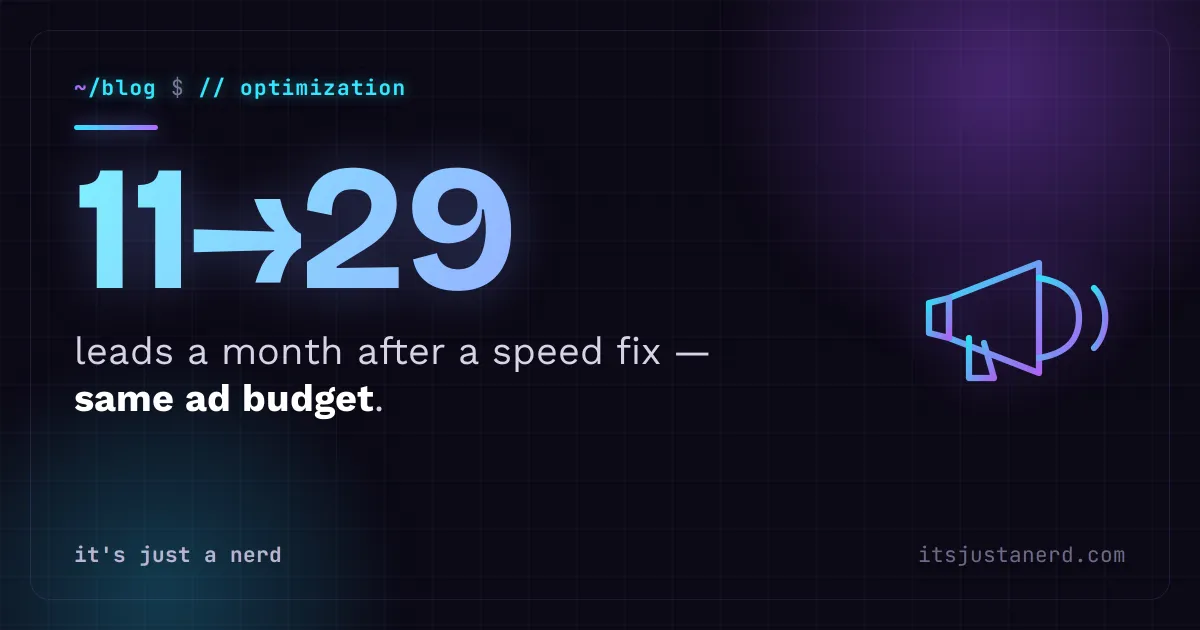
A landscaping company in the Phoenix area was spending around $1,800 a month on Google Ads with decent click volume but almost no inquiry form submissions. When I looked at the site, the landing page had a hero image, a paragraph about their "commitment to excellence," and a phone number buried in the footer. No reviews. No photos of real yards. No prices or even rough ranges. We added eleven before-and-after photos from real jobs, moved three Google reviews onto the page with the customer's first name and neighborhood, and put a simple quote-request form in the first screen. Same ad budget the next month. Inquiries went from 4 to 23. The ads did not change. The site did.
I know the instinct. You want more customers, ads feel like the fastest path, so you set up a campaign and see what happens. What happens is you spend $600 to $2,400 learning that your site does not convert. Then you either give up on ads or keep spending because you convinced yourself they just need more time.
They do not need more time. They need a site worth sending people to.
Speed, clarity, and proof are not complicated fixes. They do not require a full redesign in most cases. But they make an enormous difference in whether the traffic you pay for actually turns into business. Once people do contact you, booking, reminders, and follow-up are the next thing to get right so that interest does not quietly drain away.
Fix the foundation, then buy the traffic. When you are ready to figure out what your site actually needs, tell me what you have and we will go from there.
Run your site through Google PageSpeed Insights and check the mobile score. Anything under 60 is going to hurt you. Most small business sites on cheap shared hosting land somewhere between 30 and 50.
Almost always, yes. Ads buy you attention for a few seconds. If the site is slow or confusing, that attention goes nowhere. Fixing the site first means every ad dollar goes further instead of funding a faster bounce rate.
Real reviews with a name and context, before-and-after photos of actual jobs, and specific results (not vague praise). One honest quote from a real customer beats a five-star graphic nobody believes.
Tell me what you're dealing with, an old site, a slow one, an app idea or a task eating your week. I'll reply myself, usually within a day.
Start a project → Optimization
Most small business sites take 7 to 9 seconds to load on a phone, and the fix is usually a few hours of boring maintenance, not a full rebuild.
Read it → Optimization
Three seconds is the line between a visitor and a lost lead, and most sites cross it for three boring reasons you can actually fix.
Read it → Optimization
Most contact forms look fine but silently lose leads every week, and the fixes take less than an afternoon.
Read it →